
Summary
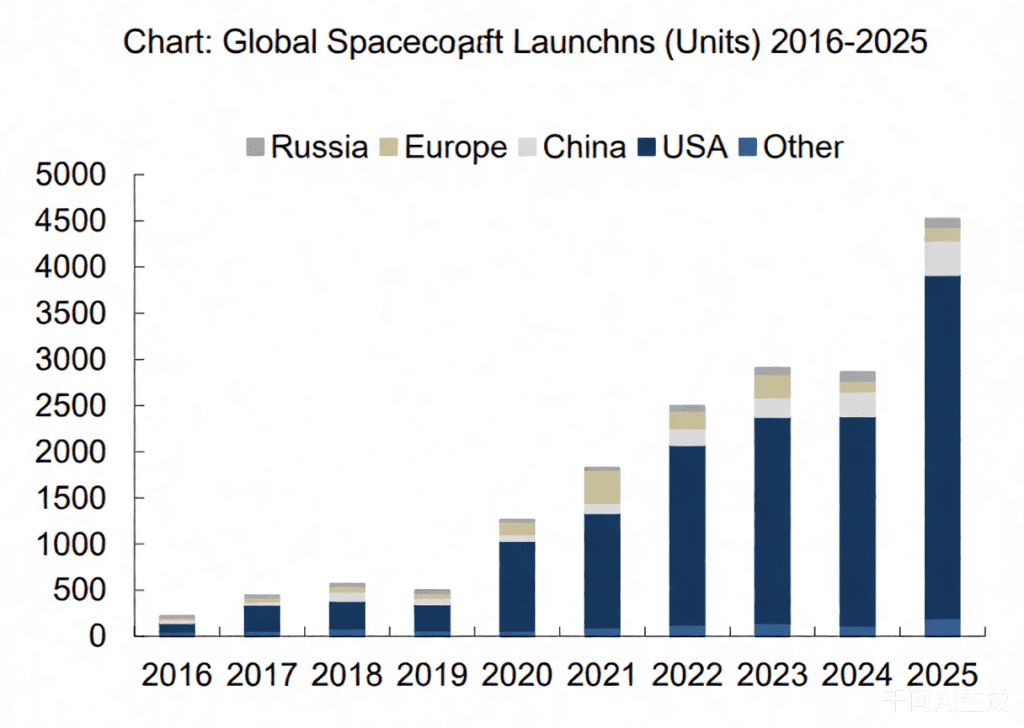
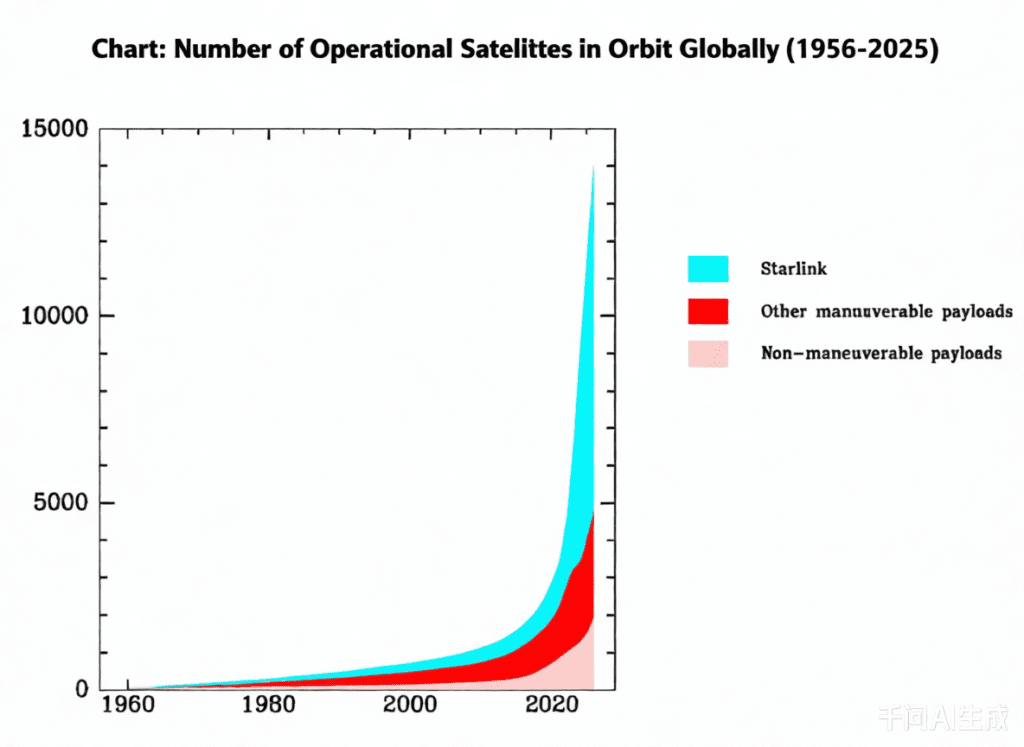
- Frontier of Technological Competition, Commercial Aerospace on the Rise. With the maturation of reusable rocket technology, space launch costs have dropped significantly, gradually breaking down the economic barriers to entering space. The scarcity of satellite frequency and orbital resources is driving nations to accelerate the race to secure these strategic resources, with the global number of spacecraft launches continuing to grow rapidly. Over the past 10 years, the global number of spacecraft launched has grown from 237 in 2016 to over 4,300 in 2025, a CAGR of 34%; the increase from 2024 to 2025 exceeds 50%. The global number of operational satellites in orbit has surpassed ten thousand, with over 100,000 filed for registration, and the number of subsequent launches is expected to expand further.
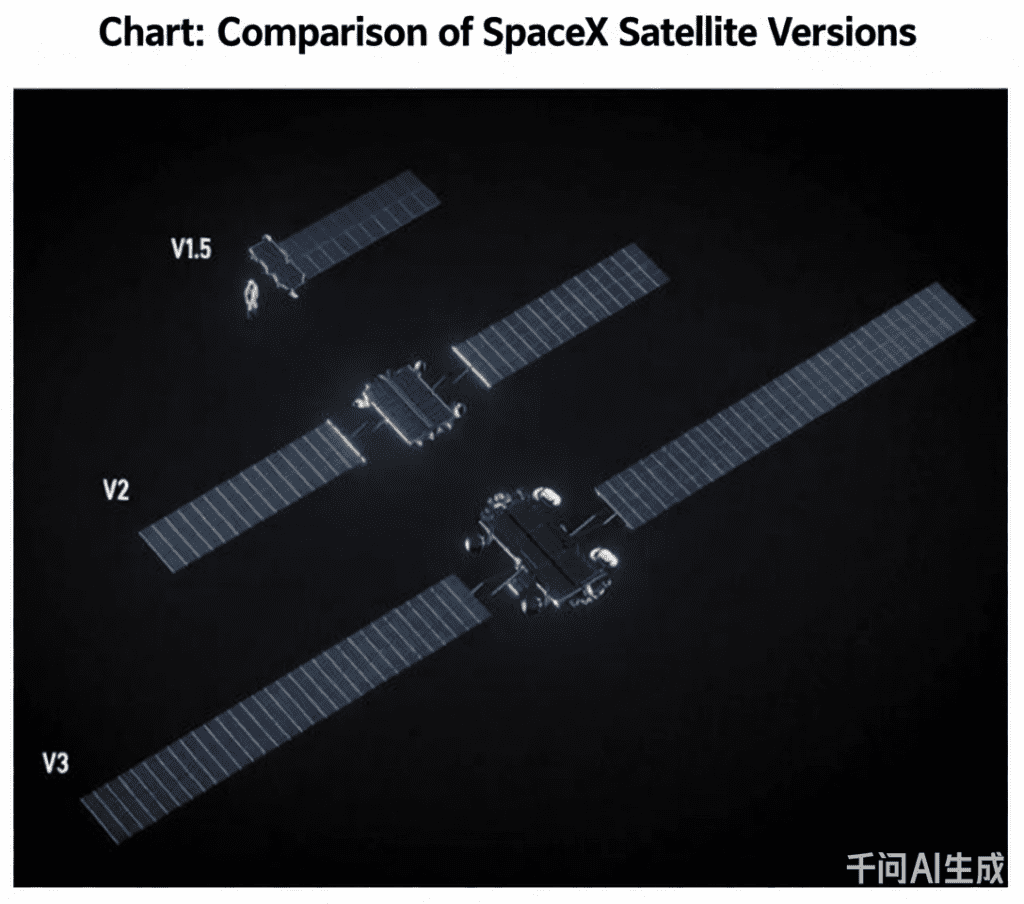
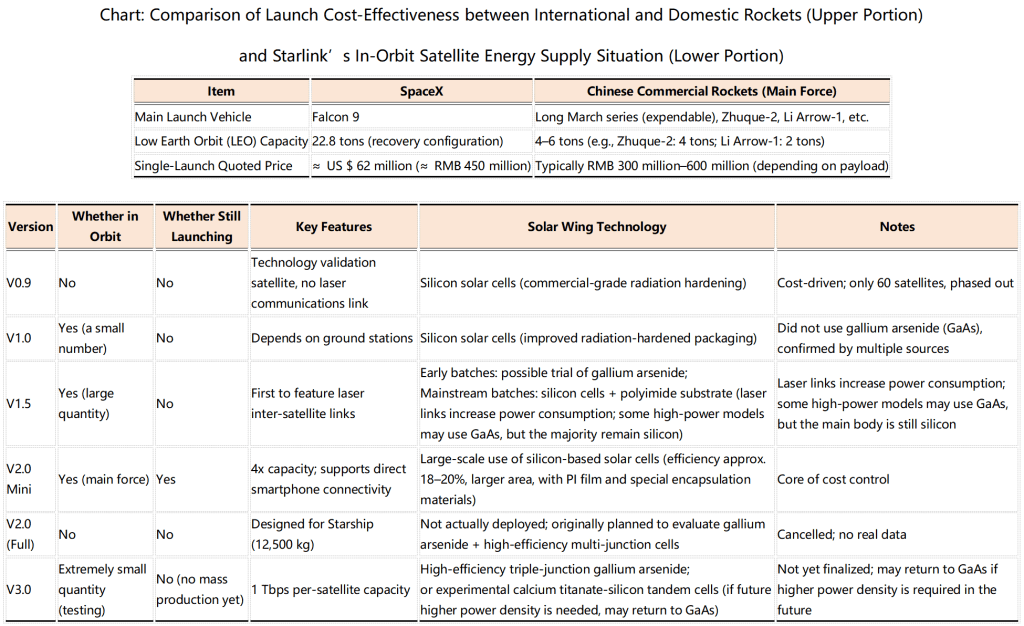
- Photovoltaics is the only efficient, long-term stable energy form for satellites; solar array usage increases with power consumption growth. The satellite power system accounts for about 20-30% of the total satellite manufacturing cost, with the solar array being the energy heart of spacecraft in-orbit operation. It requires special materials and extremely high reliability, accounting for over 60% of the value. The current mainstream gallium arsenide (GaAs) arrays cost approximately 28,000 – 43,000 USD per square meter. With the evolution of LEO constellations towards multi-functionality and heavier mass, single-satellite power is gradually increasing. The solar array area of SpaceX’s Starlink V3 satellite has grown over 10 times compared to earlier versions. Payload upgrades drive the expansion of solar array usage, with large-area, high-efficiency solar arrays becoming key for commercial aerospace equipment.
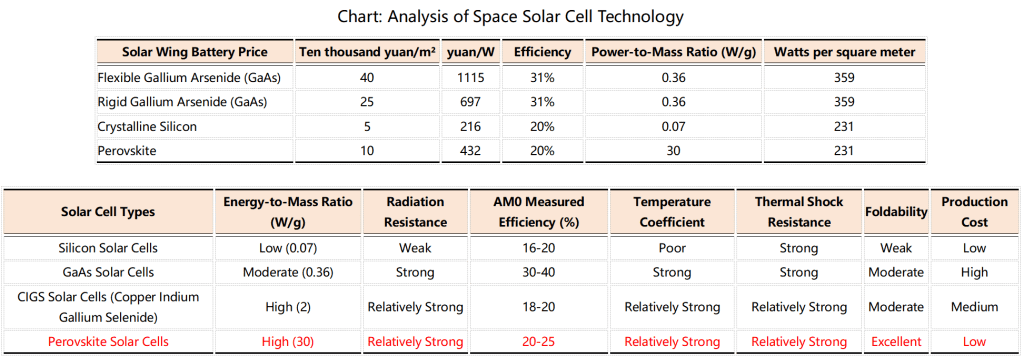
- Technological pathways have not yet converged, with potential for continuous optimization. Gallium arsenide is the mainstream technology, offering high efficiency and clear advantages in radiation resistance; module efficiency can exceed 30%, but costs are high, reaching 28,000 – 58,000 USD per square meter, estimated at about 140+ USD per watt. Its high cost and limited supply may constrain the mass production of large-scale satellite constellations. Internationally, entities like SpaceX, with lower rocket launch costs, can opt for lower-cost P-type crystalline silicon routes despite its lower power-to-mass ratio and heavier weight. Perovskite solar cells show significant potential with advantages in lightweighting, high specific power, low cost, and stability, promising to become a superior solution for space power supply.
- LEO satellites hone technology + significant potential for space computing demand, broad prospects for space photovoltaics. Global LEO satellite deployment is entering an explosive growth phase. Driven by the ITU’s “first-come, first-served” rule, nations are intensively filing constellation plans to lock in scarce orbital and spectrum resources. By the end of 2025, over 100,000 satellites had been filed globally, with the US leading with Starlink (approx. 42,000) and China filing over 51,000 through plans like GW and Qianfan. Assuming an annual launch of 10,000 satellites, this could create a nearly 3 billion USD solar array market space. The surge in AI computing demand is pushing computing power to migrate to space. Leveraging the advantages of solar irradiance in LEO and the space cooling environment, space computing can achieve high power and low latency operation.
Contents
Soochow Securities
- Part 1: Commercial Aerospace on the Rise, Space Photovoltaics Offers Optimal Power Supply
- Part 2: Technological Pathways Have Not Yet Converged, Potential for Continuous Optimization
PART 1: Commercial Aerospace on the Rise, Space Photovoltaics Offers Optimal Power Supply
Commercial Aerospace on the Rise, Space Photovoltaics Offers Optimal Power Supply
1. Developing Space is the General Trend; Aerospace Launches Expected to See Historic Growth
◆ Space has become a new battlefield for strategic competition among major powers. Satellite deployment scale is experiencing explosive growth, making the race to secure orbital resources urgent. Global space launch activities have entered an “exponential” growth cycle. The US, leveraging its commercial aerospace advantage, holds absolute dominance in launch numbers and on-orbit inventory, with annual payloads launched into orbit exceeding 2,000 satellites. Meanwhile, China is accelerating its catch-up, steadily increasing launch frequency. Given the “non-renewable” nature of LEO frequency bands and orbital positions, entering space is not only a competition for physical space but also a race to secure future sovereignty over aerospace information and national defense security. In this “first-come, first-served” land grab, accelerating the construction of autonomous and controllable space infrastructure has become a strategic imperative. In 2025, global spacecraft launches exceeded 4,300, a year-on-year increase of over 50%.
2. Launch costs are declining exponentially; commercial aerospace is experiencing its “Moore’s Law” moment.
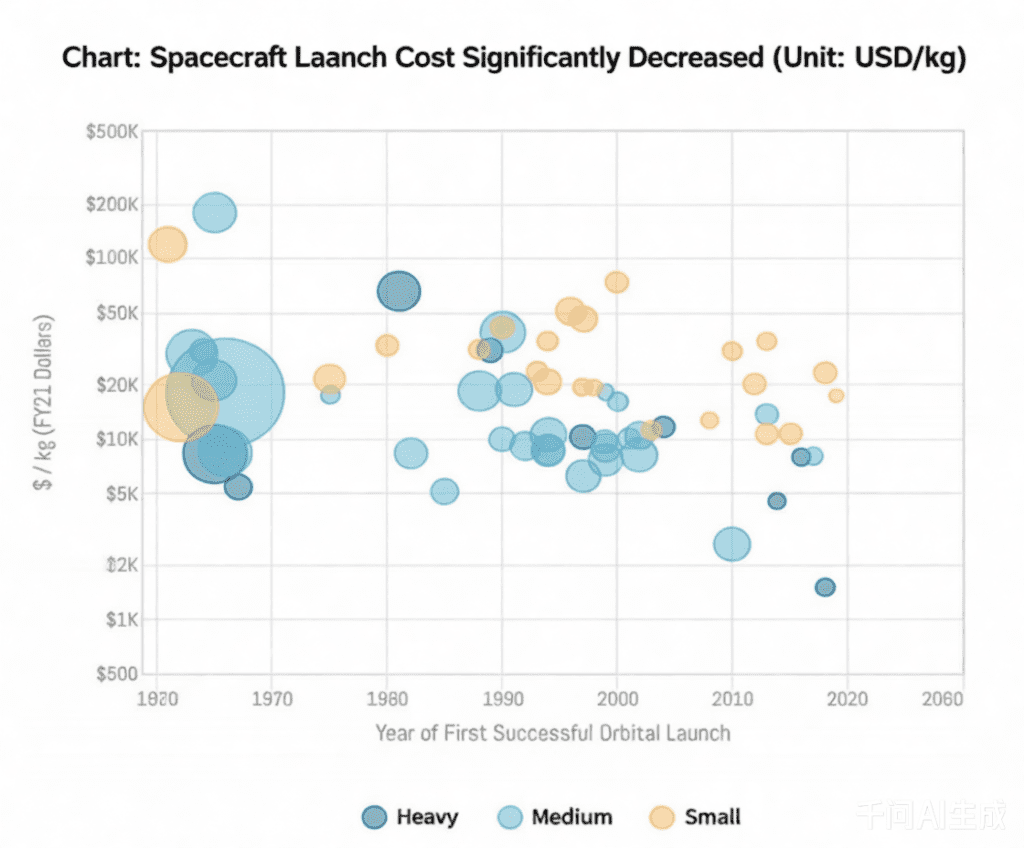
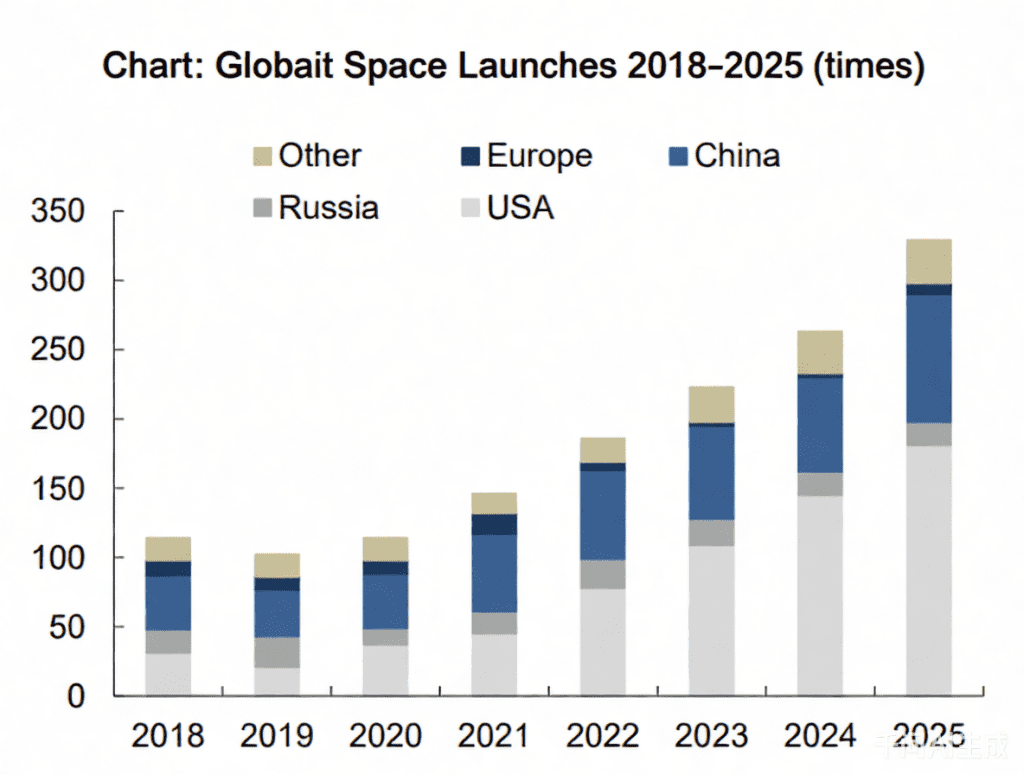
◆ The maturation of reusable rocket technology has caused a precipitous drop in the cost of placing spacecraft into orbit, completely breaking the economic barrier to entering space. High-frequency, large-scale launches are expected to become a definitive industry trend. In 2025, global spacecraft launches exceeded 300, doubling compared to 2021. Simultaneously, the expansion of space economy scenarios is reshaping the boundaries of the space industry. The space economy is extending into computing and manufacturing. LEO resource development is evolving from communication constellations to more diverse, high-value scenarios. Leveraging space’s natural low-temperature cooling advantages, new infrastructure like space data centers is moving from concept to reality, greatly expanding the commercial landscape for human space development.
3. Photovoltaics: The Only Reliable Energy Source in the Space Environment, Prospects as Vast as the Starry Sea
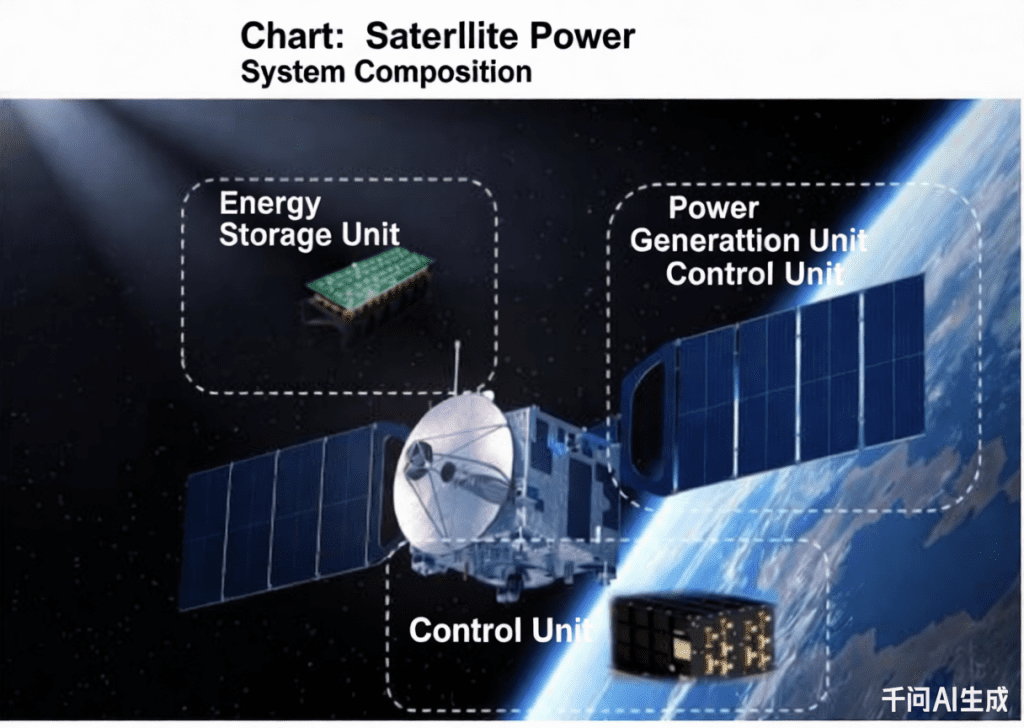
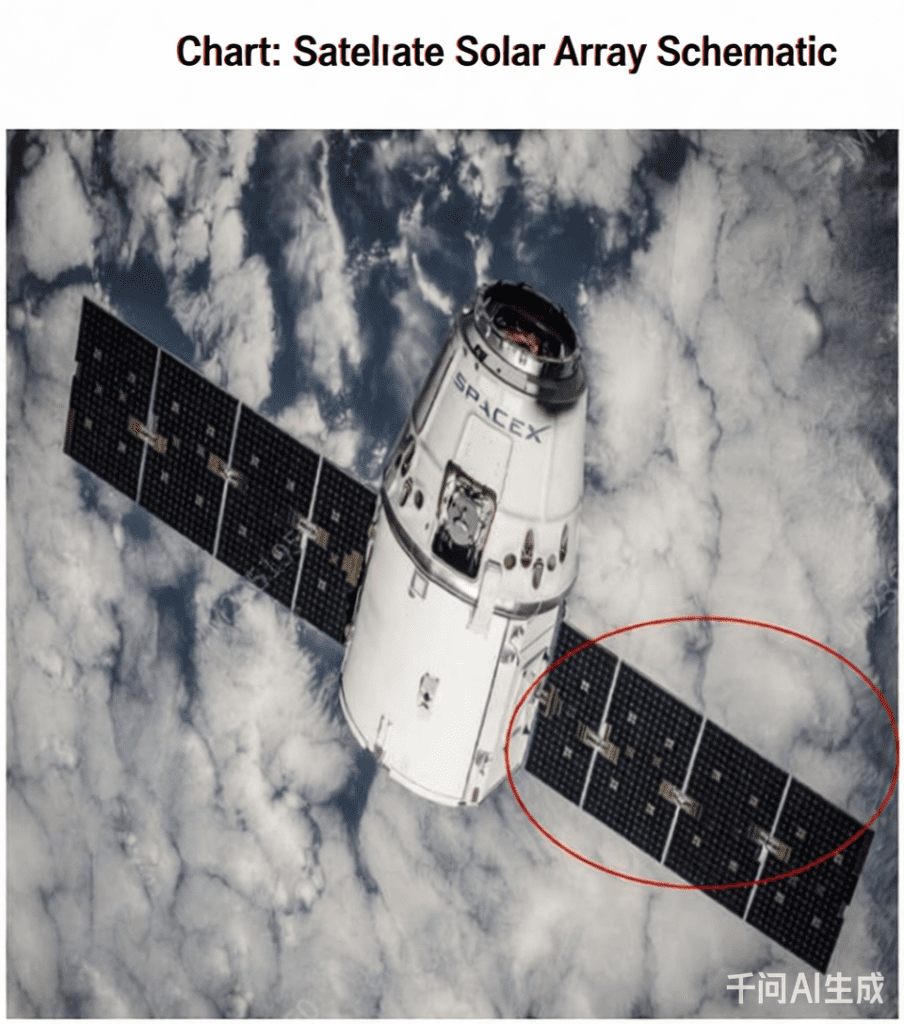
◆ Solar energy is the only efficient, long-term energy supply method in space, and solar cells are key to power supply capability. The power subsystem is the “heart” of a spacecraft, providing electrical power to its equipment. Currently, most spacecraft and near-space vehicles require support from aerospace power systems for autonomous activities, such as satellite orbit changes and communications. The typical model is a combined solar array-battery pack power system, consisting of three main components: the space solar array (solar wing), space lithium-ion battery pack, and power control equipment. The solar wing generates electricity via the photovoltaic effect to power equipment, serving as the power source for the satellite system.
4. Satellite Energy System Constitutes a Relatively High Cost Share, Primarily Photovoltaic Cells
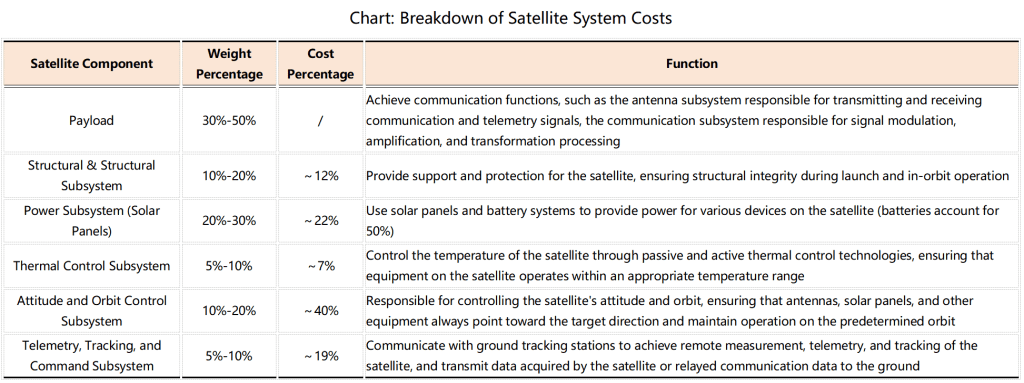
◆ The power system is the energy source for satellite operations in orbit. Its weight can account for up to 30% of the total satellite weight, with a cost share of about 22%. Photovoltaic cells constitute over 50% of this, determining power supply capability and output. The solar wing is the power plant of the spacecraft, holding a high value share within the energy system. The space solar array (solar wing) is an array composed of many solar cells, converting solar energy from the space orbit into electricity for spacecraft use, acting as the primary power source for the spacecraft’s power subsystem. Within the satellite power system, the solar wing typically accounts for 60%-80% of the value, significantly higher than the space lithium-ion battery pack and power control equipment.
5. Satellite Payload Upgrades Expected to Drive Volume and Price Increase for Solar Wings
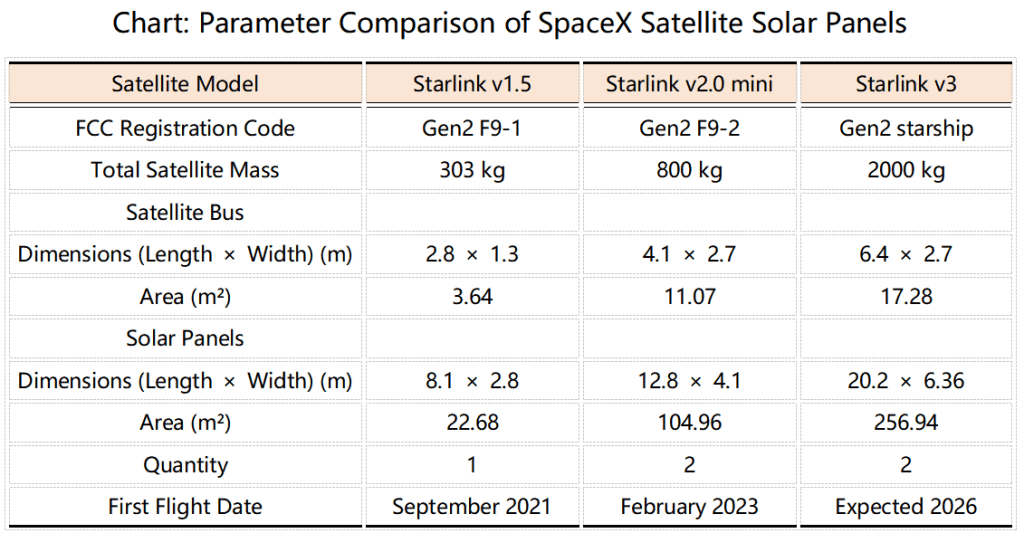
◆ Spacecraft power requirements are steadily increasing, demanding higher power from energy systems and continuously larger solar wing areas. As Starlink satellite mass and power increase generationally, its solar wing area has evolved from 22.68 m² for V1.5 to 256.94 m² for V3, achieving an order-of-magnitude growth. Payload upgrades are driving the space photovoltaic industry from pure component manufacturing towards a vast “volume and price increase” blue ocean. Ultra-large area, high-conversion-efficiency solar wings will become a core resource for future commercial aerospace competition.
6. Satellite Payload Upgrades Expected to Drive Volume and Price Increase for Solar Wings
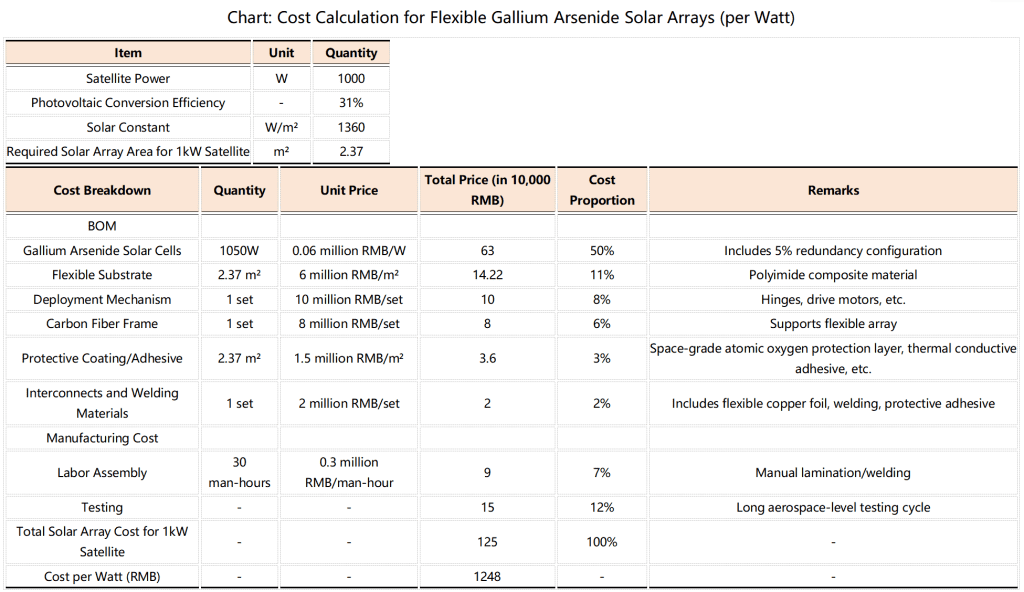
◆ Within satellite solar wing costs, cell wafers account for a relatively high proportion. Taking flexible GaAs solar wings as an example, referencing market prices, we estimate that maintaining a 1kW satellite’s normal in-orbit operation requires a solar wing area of approximately 2.37 m². The total required BOM and manufacturing cost is about 1.25 million RMB, corresponding to a solar wing cost of over 1200 RMB per watt.
PART 2: Technological Pathways Have Not Yet Converged, Potential for Continuous Optimization
Technological Pathways Have Not Yet Converged, Potential for Continuous Optimization
1. Technology: GaAs is Mainstream Domestically, with Clear Advantages in Efficiency and Radiation Resistance
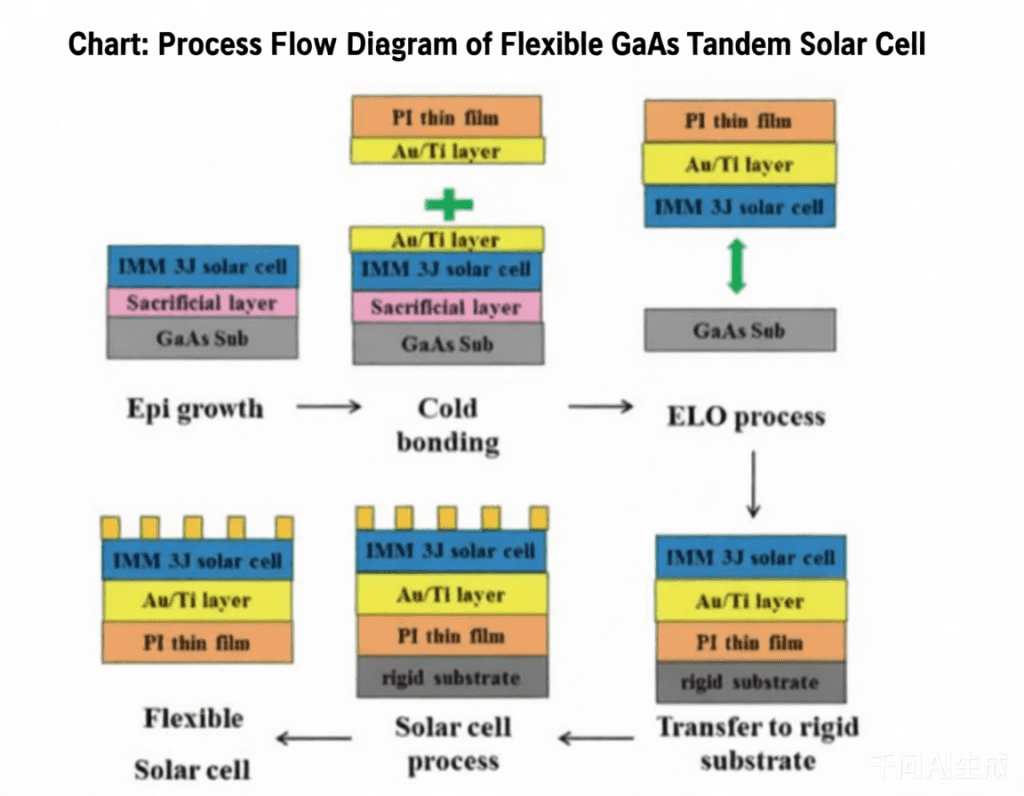
◆ GaAs cells are the current mainstream space cells, with low-cost new materials continuously developing. Unlike ground-based PV cells which pursue scale manufacturing and low cost, the core value of space solar cells lies in extreme performance and reliability, serving as the lifeline for various spacecraft like satellites, space stations, and deep-space probes. In the history of aerospace power development, the solar array as the primary power source has undergone four revolutions: silicon solar cells → single-junction GaAs solar cells → multi-junction GaAs solar cells → thin-film GaAs solar cells.
Evolution of Space Photovoltaic Cell Technology
Before the 1980s
Spacecraft primarily used silicon solar cells as the power generation unit. They offered mature processes, low production cost, and high mechanical strength. Through process improvements, the photoelectric conversion efficiency of space silicon cells increased from an early ~12.3% to over 15%.
1990s
Single-junction GaAs cells began replacing silicon as the basic power generation unit for spacecraft. Compared to silicon, GaAs has a bandgap width of 1.42eV, matching the solar spectrum better. Single-junction GaAs cell efficiency reached 25%, with better high-temperature resistance, radiation resistance, and higher photoelectric conversion efficiency.
Since the 21st Century
With the development of technologies like Metal-Organic Chemical Vapor Deposition (MOCVD) and tunnel junction series connection, triple-junction GaAs solar cells achieved engineering mass production and space application. Compared to single-junction GaAs, triple-junction cells offer higher photoelectric conversion efficiency, better space environment adaptability, and strong lattice matching between different cell layers.
2. GaAs: High Efficiency + High Reliability, Suitable for High-End Application Scenarios
◆ GaAs cell high efficiency and reliability suit high-end application scenarios. 1) GaAs bandgap (1.42eV) is within the theoretically optimal range, and multi-junction cells composed of GainP, GaAs, Ge layers absorb high, medium, low-energy photons respectively, greatly broadening spectral utilization. 2) Strong radiation resistance and excellent high-temperature stability make it perfectly suited to core needs of high-value/long-life missions, with performance advantages offsetting high costs. 3) For the cost and scale pursued by large constellations, GaAs’s high cost and limited production capacity become major obstacles, creating competition space for low-cost technologies like perovskites.
3. Perovskite: Candidate for Next-Generation Space Photovoltaic Material
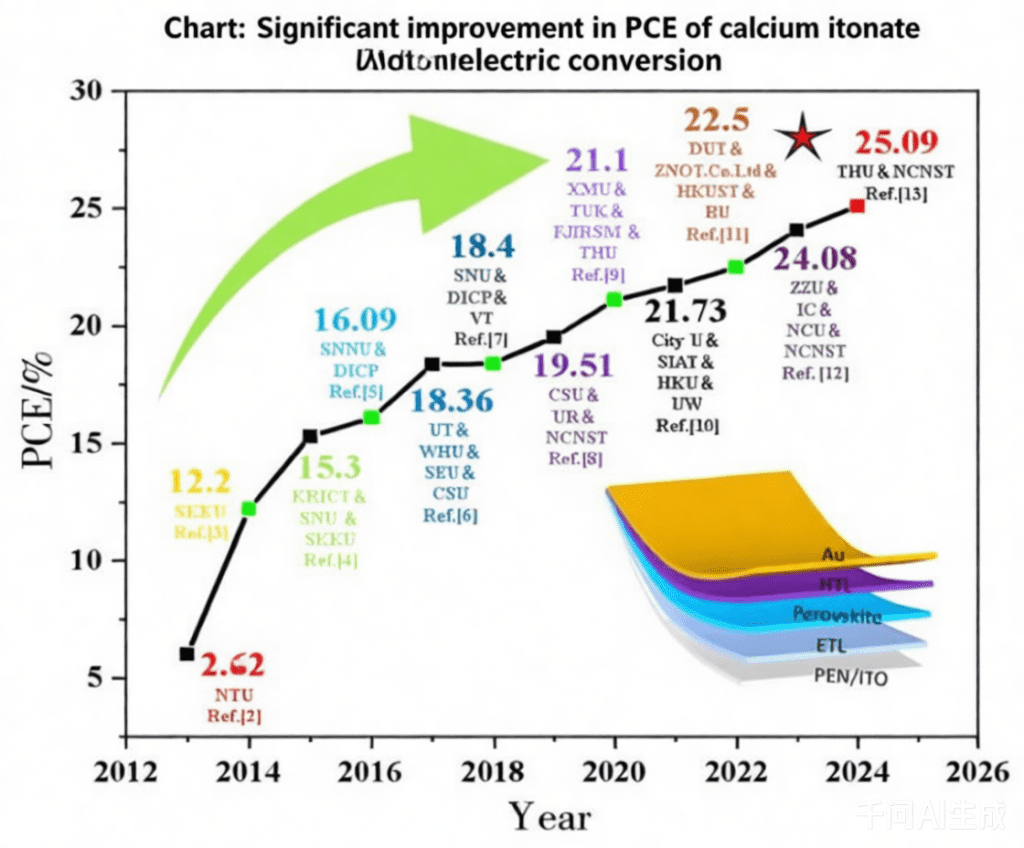
◆ Perovskite technology achieves dual breakthroughs in extreme cost reduction and efficiency leap. 1) Unlike traditional crystalline silicon and GaAs cell fabrication, perovskite uses low-temperature (150°C) coating/printing processes. All process steps can be completed in a single factory, significantly reducing capital expenditure requirements for manufacturing equipment. Raw materials are abundant and low-cost, with adjustable formulas and wide composition selection, giving perovskite a potential for order-of-magnitude cost reduction. 2) Perovskite has an extremely high light absorption coefficient; a thickness of only 300-500nm is sufficient to absorb most visible light, reducing the weight of the power-generating material. 3) From a performance perspective, its conversion efficiency leaped from 2.62% to over 25% in just over a decade. Furthermore, multi-junction perovskites can cover a wider solar spectrum range through different bandgap combinations, achieving segmented absorption of photons at different wavelengths, further improving spectral utilization.
4. Perovskite: High Potential, Potential for Future Low-Cost Substitution
◆ Perovskite cells possess advantages in lightweighting, high specific power, low cost, and stability, potentially becoming the ultimate solution for space power supply. However, current challenges remain: Ground-based photovoltaic perovskite cells have poor adaptability to the space environment. The space environment is harsher than ground, with high/low temperature cycles, high-energy particle radiation, UV light, atomic oxygen, etc., imposing extremely high requirements on material selection, cell structure selection, and encapsulation material selection for perovskite cells.
5. Crystalline Silicon: Lower Launch Costs Overseas Allow Choice of Low-Cost Crystalline Silicon Route
◆ The level of launch cost influences technological pathway selection. Due to low launch costs (~1,500 USD/kg), SpaceX can choose low-cost crystalline silicon cells, compensating for efficiency by increasing area. In contrast, China, with higher launch costs, still tends towards high-specific-power but expensive GaAs cells.
6. Crystalline Silicon-Perovskite Tandem Technology Holds Great Promise
◆ Continuous improvement in crystalline silicon cell photoelectric conversion efficiency, coupled with disruptive breakthroughs in perovskite tandem technology. N-type crystalline silicon cell technologies represented by TOPCon, Heterojunction (HJT), and XBC are steadily pushing photovoltaic cell conversion efficiency towards theoretical highs above 27%. However, the physical limits of single-structure materials are becoming increasingly apparent. Against this backdrop, crystalline silicon-perovskite tandem technology offers a new paradigm for breaking the Shockley–Queisser limit. By constructing a tandem structure of a perovskite top cell and a crystalline silicon bottom cell, this technology achieves precise graded utilization of the solar spectrum—the top layer efficiently absorbs high-energy short-wave radiation, while the bottom layer captures low-energy long-wave photons. This spectral complementary mechanism significantly improves full-spectrum photon utilization, boosting photoelectric conversion efficiency, and is expected to become a transitional technological pathway for space photovoltaic cells.